FM27 match engine: what actually changed
Faster is not always better. The FM27 match engine asks you to respect acceleration, stamina and defensive positioning — then gives you new tools to react from the touchline.
On this page
What changed in the FM27 match engine?
This is an evolution of the engine, not a ground-up replacement. Sports Interactive has focused on player movement, defending, attacking the box, stamina and in-match control. The visual presentation is improved too, but the important changes are behavioural: how quickly players move, how they recover, where they run and how your instructions translate into action.
For FM27, the match engine also has to support the new Tactical Tweaks system. That means more of your decisions are available live, and the opposition manager can respond. A match is now less about choosing the right preset and more about diagnosing the problem in front of you.
Movement and speed: more realistic, less forgiving
Acceleration and running speed have been rebuilt using Hawk-Eye data. Players no longer accelerate unnaturally quickly to recover after being beaten, and off-ball runners cannot turn at physics-defying angles. In broad terms: fast players still look fast, but slow defenders are exposed more honestly.
New animations include body feints, elasticos and heel chops, with skill execution tied to Flair and Dribbling. That gives technical wingers and forwards more individual expression. Defenders, meanwhile, use new jockeying movements rather than relying on a sudden burst of speed.
A high defensive line is now a clearer bet on your centre-backs’ pace and anticipation. If you do not have recovery speed, protect the space instead of pretending it is not there.
Stamina now shapes the last 20 minutes
FM27 gives Stamina more influence on how much ground a player can cover, how quickly they recover between sprints and how condition deteriorates during the match. A wing-back who repeatedly drives forward will visibly tire. A low-stamina presser may become a passenger after 70 minutes. Substitutes can have a greater impact on the result.
This does not mean every squad needs 20 stamina players. It means your tactical plan has to account for the physical cost. If you press high and attack with both full-backs, you need rotation options and a bench that can sustain the intensity. Training workload and recovery also become part of match preparation rather than a separate spreadsheet.
- High press: prioritise stamina and natural fitness across the front five.
- Wing-back system: keep one full-back more conservative or plan early substitutions.
- Low block: concentration and positioning matter more than repeated sprint capacity.
Defending: the duel is back
FM27 places more weight on Marking, Anticipation and intelligent body positioning in one-v-one defending. Defenders can jockey, delay and force an attacker away from goal instead of relying on an unrealistic recovery sprint. That makes elite defenders feel more valuable and weak defenders easier to target.
The practical test is to watch your full-backs against a quick winger. If they are repeatedly turned, do not simply add “close down more”. Consider a lower line, a more conservative full-back duty or a midfielder dropping to protect the channel. The engine rewards the structure before the instruction.
Attacking the box: more than one run
Player Instructions now allow you to define how a player attacks the penalty area. Depending on the position, you can ask him to attack the near post, the far post or the central area, or to arrive late. That creates more variety in crosses, cutbacks and double movements.
Mental attributes matter. Players with high Anticipation and Off the Ball will time runs better. A team with poor cohesion may double up in the same zone or make the wrong run. The instruction is not a guarantee; it is a starting point for smarter movement.
For a 4-2-3-1, a simple pattern is: right winger stays wide, striker attacks the near post, left winger attacks the far post, No.10 arrives late. That fills three different zones and gives the ball carrier a clear decision tree. Our 4-2-3-1 blueprint uses exactly that logic.
Tactical Tweaks: the touchline control layer
Tactical Tweaks let you change team or individual behaviour from the matchday screen. Examples include increasing urgency, going longer, exploiting width or reducing the press. You can also swap wingers or send the goalkeeper forward for a late set piece. Tweaks remain active until you remove them.
The best use is not to press every button. It is to solve one problem at a time:
- Identify why you are losing the ball or conceding chances.
- Make one tweak that addresses the cause.
- Watch for two or three minutes of match time before stacking another change.
- Remove the tweak when the opponent adapts.
If your midfield is being overrun, “more urgency” will not fix it. Drop a midfielder deeper, narrow the width or reduce the press first.
Shouts: emotional direction, not a cheat code
Shouts have been rebuilt with more contextual explanations and a stronger effect on player mentality and body language. The result is more individual: a player’s personality and the match context influence how he reacts. A passionate dressing-room leader may respond differently from a nervous youngster.
Use shouts sparingly. Constant shouting loses meaning. If you are losing, a clear instruction with a tactical tweak is usually more useful than an emotional blast with no structural change.
Match data, heat maps and the 2D view
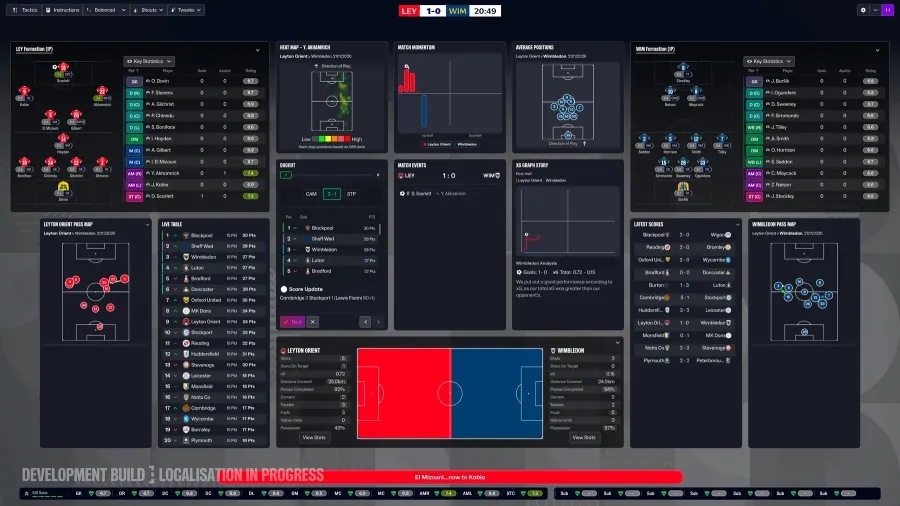
The between-highlights screen is more customisable, with tile swapping and adaptive layouts. Match data includes returning heat maps and action zones, pass maps after the match and a refreshed Data Hub. The 2D Match View has also been upgraded, which is useful if you prefer to read shape rather than watch the 3D rendering.
For tactical diagnosis, use heat maps to spot the gap between your defensive and midfield lines. Use pass maps to see whether your buildup is actually progressing through the midfield or just circulating between centre-backs. Do not use raw possession as a proxy for control.
How to adapt your FM27 tactics
The most reliable approach is to give the engine a simple problem to solve. Start with a clear rest defence, a defined pressing height and a coherent set of attacking runs. Then make adjustments based on what you see, not what a content creator promised.
- If your defenders are turned repeatedly: lower the line or protect the channels with a holding midfielder.
- If your press is bypassed: reduce pressing intensity, narrow the block and stop the easy switch.
- If your forwards are isolated: add a runner from midfield or change the striker’s movement, not just the tempo.
- If your team fades late: check stamina, training load and substitutions before changing the tactic.
For system-level feedback, read Tactical Effectiveness. For structural options, browse the FM27 tactics room.
FM27 match engine FAQ
Why do my defenders feel slower in FM27?
FM27 recalibrates acceleration and recovery runs against real match data. Defenders no longer make unnatural catch-up bursts, so a high line exposes slow centre-backs more clearly. Lower the defensive line or recruit for recovery pace.
Does stamina matter more in FM27?
Yes. Stamina has a stronger influence on repeated sprint ability, condition loss and late-game performance. Rotation and substitutions matter more, especially if you use a high press.
Do Tactical Tweaks replace the tactics screen?
No. They are quick in-match adjustments for urgency, passing length, width, pressing or individual instructions. Structural changes, role changes and major tactical overhauls still happen in the tactics screen.
Can I use a high press in FM27 with a lower-league team?
You can, but it is a risk. Lower-league players may lack the stamina, anticipation and tactical understanding to sustain it. A mid-block with selective pressing is often more reliable.
Sources
- Sports Interactive — Tactical Tweaks and Match Engine UpgradesOfficial deep dive, 5 October 2026.
- Sports Interactive — FM27 key featuresOfficial feature hub.
Field notes
This guide is based on official FM27 information and our own analysis of the systems shown so far. Ratings and in-game examples from the Launch Preview can change before launch. Last checked 31 October 2026.