FM27 training: build the week around the match
Training is no longer a background attribute slider. In FM27 it is the place where tactical understanding, physical condition and squad belief are built — or wasted.
On this page
What changed in FM27 training?
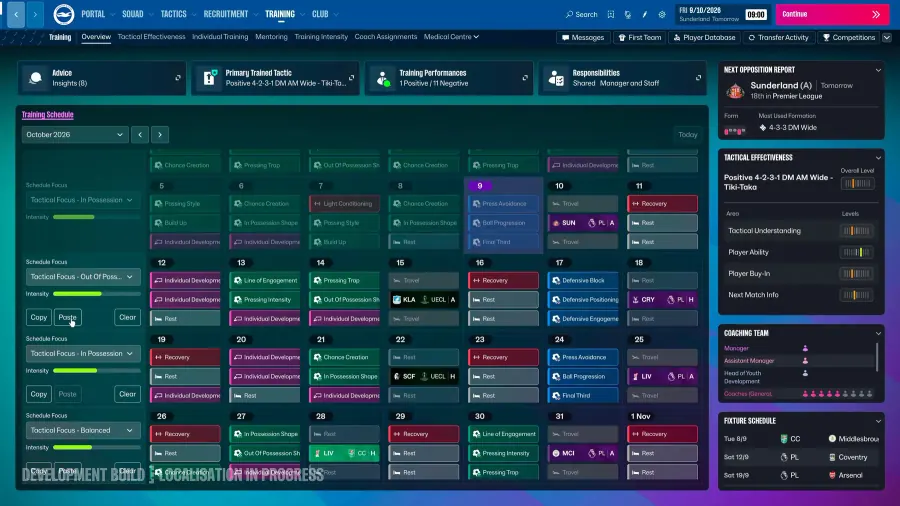
Training moves into FM27’s primary navigation and receives an interface refresh. Copy-and-paste plans are back, workload forecasts extend beyond the current week and each squad has a clearer purpose. Senior training is now tilted toward match preparation: team cohesion, tactical understanding and the specific behaviours required for the next opponent.
The old units system has been replaced with sessions that connect to how you want to play. You can train a high press, a low block, build-up patterns or defensive transitions. Individual training remains for long-term player development, including attributes, traits and new positions.
The key consequence is that “train hard every day” is no longer a strategy. You are trying to improve execution while keeping the squad fresh enough to execute. Tactical Effectiveness is the feedback loop: understanding, ability, buy-in and next-match information.
Five principles for an FM27 training week
- Build backwards from matchday. Recovery, preparation, activation. The final session should sharpen the plan, not introduce it.
- Train the tactic you actually use. A possession session is not useful if you play direct, low-block football.
- Protect the key attribute groups. A high press needs endurance and recovery; a possession side needs technical work under pressure.
- Keep individual development separate. Team preparation and a wonderkid’s long-term pathway are different jobs.
- Cut volume before intensity. When the schedule gets congested, remove optional sessions rather than compromising recovery.
A reliable FM27 weekly training template
This is a starting point for a normal Saturday-to-Saturday week with one match. Adjust for your tactic, squad condition and the opponent. Session names can differ slightly by edition; the principle matters more than the label.
| Day | Primary focus | Supporting work | Intensity |
|---|---|---|---|
| Sunday | Recovery | Individual recovery, light technical work for substitutes | Low |
| Monday | Rest / recovery | Review, medical checks, low-intensity individual development | Low |
| Tuesday | Tactical shape | Defensive organisation, unit cohesion, possession under pressure | Medium-high |
| Wednesday | Attacking pattern | Final-third movement, transitions, finishing, set pieces | High |
| Thursday | Match preparation | Opposition-specific plan, pressing triggers, rest defence | Medium |
| Friday | Activation | Short shape rehearsal, set-piece review, recovery for starters | Low-medium |
| Saturday | Matchday | — | — |
A midweek European fixture or a Sunday match changes the whole week. Move the high-intensity sessions earlier and protect at least two recovery windows.
Train your tactical style, not a generic schedule
High press / gegenpress
Prioritise pressing coordination, endurance and defensive transitions. The front five need repeated exposure to the trigger, but they also need recovery. If your press is already at maximum complexity, adding more tactical sessions can reduce sharpness. Train the shape, then let the players recover.
Possession / control
Build sessions around playing out of pressure, third-man combinations and rest defence. Technical work matters, but the tactical understanding of where to stand after a turnover is just as important. Use match preparation to rehearse the opponent’s pressing pattern.
Low block / counter
Defensive shape, compactness, second-ball reactions and direct transitions are the core. The low block is mentally demanding rather than physically explosive, so you can afford more tactical repetition — but concentration drops when players are fatigued.
Our formation guides include tailored training blocks for each blueprint: 4-3-3 gegenpress, 4-2-3-1 control and 4-4-2 low block.
Workload and recovery: the invisible selection decision
FM27 gives you better visibility of the physical load ahead. Use it. A player at high risk is not just an injury waiting to happen; he is also unlikely to execute a demanding tactical instruction properly. The match engine’s stronger stamina model makes that trade-off more visible on the pitch.
- Rotate your wide players and wing-backs before they reach the red zone.
- Use individual training to maintain development without adding team-session load.
- Reduce intensity after a midweek match rather than removing recovery entirely.
- Do not use a high-intensity press week after week with the same front five.
Individual training: the long game
Individual training is where a young player becomes a first-team option. Focus on the attributes and traits that the role actually needs, not a generic development checklist. A young wing-back needs stamina, crossing and defensive positioning. A playmaker needs first touch, composure and vision. A pressing forward needs work rate, stamina and anticipation.
There is a genuine opportunity cost. If a 17-year-old is training for the future, he may be less prepared for the next match than a senior squad player. That is a decision, not a bug. For academy prospects, a loan can be more valuable than a permanent place on the bench.
Use the wonderkid shortlist to identify profiles worth the investment, then build a development plan around their pathway to minutes.
International training camps
FM27 adds the ability to create training plans with an international team during a camp. Contact time is short, so the priority is cohesion and a small number of match-specific behaviours. Do not try to install a completely new system in a week. Choose the shape, rehearse the defensive transitions and keep the set-piece roles clear.
A simple pre-season plan
Pre-season is not about winning friendlies. It is your best chance to install the tactical foundation without competitive pressure. A practical structure:
- Week one: physical base and recovery. Keep tactical instruction light.
- Week two: shape and pressing triggers. Begin Tactical Understanding work.
- Week three: attacking patterns and set pieces. Increase match preparation.
- Week four: opposition-specific work and fine-tuning. Reduce total volume before the opener.
If you change tactics late in pre-season, accept that the effectiveness gauges may start lower. That is the trade-off. The alternative — changing the system after two competitive defeats — is usually worse.
FM27 training FAQ
How important is training in FM27?
More important than in recent editions because first-team training is now directly tied to match preparation and Tactical Effectiveness. A good schedule builds understanding of your plan, not just individual attributes.
Should I use match preparation every week?
Yes, but balance it with recovery. The exact mix depends on fixture congestion, squad condition and how new the tactic is. A normal one-match week can support two or three tactical sessions.
Does individual training still matter?
Yes. Individual training remains the main lever for long-term attributes, traits and positional development. You have to balance a player’s development pathway with the team’s short-term match preparation.
Can I copy training schedules in FM27?
Yes. The ability to replicate training schedules has returned. Use it for repeatable weeks, then adjust recovery and match prep for congestion or a new tactic.
Official sources
- Sports Interactive — Training & Tactical EffectivenessOfficial deep dive, 9 October 2026.
- Sports Interactive — FM27 key featuresOfficial feature overview.
Field notes
This guide is based on official FM27 information and our own analysis of the systems shown so far. Ratings and in-game examples from the Launch Preview can change before launch. Last checked 31 October 2026.