FM27 beginner’s guide: your first save, without the noise
You do not need to understand every screen in Football Manager 27 before you press continue. You need a club, a shape, a training week and a way to judge what happens next.
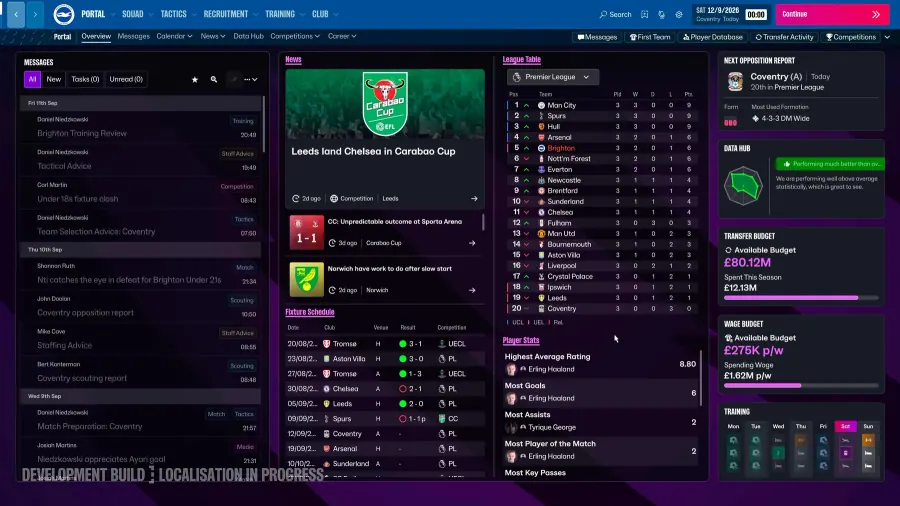
On this page
1. Choose a club that gives you room to learn
The first decision in an FM27 save is not “which club do I like?” It is “which problem do I want to solve?” A giant will give you resources and pressure. A mid-table side will give you room to build. A lower-league club will give you constraints and a very intimate relationship with the loan market.
For a first save, pick a club with a coherent squad and a board expectation you understand. Bayern Munich is the gentlest introduction because the squad can carry tactical experimentation. Newcastle or Brighton offer a better balance if you want a project without starting at the very top. Avoid a relegation-threatened side unless you specifically want a survival challenge.
Read the board’s season expectation, the squad age profile and the wage bill before you press continue. A club with too many players in their 30s will need a rebuild sooner than the badge suggests. A club with a huge wage bill and a modest transfer budget will limit your first window.
Our FM27 club guide ranks nine projects from gentle to hard graft. Start there if you are undecided.
2. Your first hour: set the foundation, not the whole season
It is tempting to spend an hour on every staff profile, every training slider and every scout assignment. Do not. In your first hour, do these six things:
- Confirm the board expectation. It shapes every selection and transfer decision.
- Meet the squad. Identify your best three players, the weakest unit and the leaders.
- Set one base formation. Choose a structure that suits the strongest unit.
- Hire one or two key staff. Prioritise the areas your tactic depends on.
- Create a training week. Recovery, tactical shape, attacking pattern, match prep, activation.
- Set scouting priorities. One position and one profile, not a scattergun list.
You can delegate responsibilities, but do not delegate the identity. You should be able to explain your formation, pressing height and attacking pattern in one sentence each.
3. Assess the squad without falling for star ratings
Star ratings are a guide to relative ability within your squad, not a complete tactical fit report. Look at the players who have the attributes for the jobs you need. A 3.5-star defensive midfielder with great positioning and work rate may be more important to your 4-2-3-1 than a 4-star playmaker who cannot screen the defence.
Identify:
- Your spine: goalkeeper, one centre-back, the holding midfielder, the main creator and the striker.
- Your leaders: who can hold the dressing room when results turn?
- Your athletic gap: can the squad press, or is it built to sit deeper?
- Your development block: which young player deserves a defined pathway?
Tactical Effectiveness includes Player Buy In. That makes the human side of the squad relevant. If your captain is unhappy or your best player expects a move, address it before tactical drills become the priority.
4. Set a simple tactic you can explain
Start with a 4-2-3-1 or 4-4-2 unless your squad clearly demands something else. Both give you a stable base and straightforward role pairings. Use a mid-block, a standard defensive line and a small number of team instructions. Keep player instructions to one or two players who need a specific behaviour.
The most common beginner error is stacking complexity: a high press, a high line, overlapping full-backs, short passing, a playmaker, two attacking wingers and a pressing forward, all at once. That is not a tactic; it is a wish list. FM27’s Tactical Complexity will reflect the load, and lower-league players may not be able to deliver it.
Choose one core idea:
- Control: double pivot, patient build-up, one creator between the lines. Try our 4-2-3-1.
- Press: high line, aggressive forwards, a holding midfielder behind the press. Try our 4-3-3.
- Counter: compact block, direct passing, two hard-running forwards. Try our 4-4-2 low block.
If you cannot describe where your team will stand after losing the ball, the plan is too vague. Rest defence is the foundation of every successful system.
5. Build a training week that supports the tactic
FM27 training is oriented toward match preparation. Use recovery after matches, tactical shape early in the week, attacking patterns in the middle and activation before the next fixture. Do not schedule high-intensity sessions every day.
Your first priorities should be Tactical Understanding and physical freshness. Player Buy In is influenced by the broader environment, but consistent selection and clear roles help. If you have a young prospect, individual training is the long-term lever; the team session is the short-term one.
Our FM27 training guide includes a full weekly template and a pre-season plan. Start there, then adapt for your fixture list.
6. Survive the first transfer window without panic buying
Your first window should address the gaps that make the tactic impossible, not every weak position. If your midfield cannot protect the defence, sign a defensive midfielder. If your only creative player is injured, find a short-term cover option. If a young prospect is ready, do not sign a veteran who blocks him for three years.
Before you bid, calculate the total cost: fee, wages, agent fee, signing bonus and any clauses. A free transfer on a huge wage can be more expensive than a modest fee on a sensible contract. Scouting for tactical fit is more valuable than collecting high-reputation names.
The FM27 transfer guide covers negotiation, loans and deadline-day planning. Keep your first window small and your squad coherent.
7. Matchday: watch, diagnose, adjust
Do not spend the first match on maximum speed and highlights only. Watch a full 90 minutes at a normal speed to see the shape. Look at:
- Where your team loses the ball and whether the rest defence is exposed.
- Whether the press is triggered collectively or by one player at a time.
- Whether the striker is isolated or supported by runners.
- Which player is repeatedly targeted by the opposition.
At half-time, make one adjustment. In the second half, use Tactical Tweaks only when the problem is clear. Do not confuse activity with improvement. A calm tweak to the pressing height or width is often more useful than a complete system change.
8. The first ten matches: a sensible review
Do not judge a new save by the first result. Judge the first ten matches by whether the team is doing what you asked. The results will fluctuate; the pattern should become clearer.
| Checkpoint | What good looks like | What to change if not |
|---|---|---|
| Tactical Understanding | Players occupy the right zones without hesitation. | Reduce instructions and train the shape. |
| Chance quality | You create different types of chances, not only long shots. | Adjust box runs and the final-third pattern. |
| Defensive structure | The central lane stays protected after turnovers. | Drop the line, fix the pivot or switch a full-back to defend. |
| Squad condition | Most starters are match-fit and not in the red zone. | Reduce training intensity and rotate earlier. |
| Player development | Young players are training and earning appropriate minutes. | Adjust individual training or arrange a loan. |
If you are enjoying the save but the results are poor, do not restart immediately. The most interesting FM saves are often the ones where you learn the squad and fix the problem over two seasons.
FM27 beginner FAQ
What should a beginner do first in FM27?
Choose a stable club, read the board expectation, set one simple formation and let pre-season and early matches teach you the systems. Do not change every instruction before you have seen the squad play.
Which formation is easiest for a beginner in FM27?
A 4-2-3-1 with clear roles or a compact 4-4-2 are good starting shapes. Both give you a secure base and straightforward role instructions. Avoid maximum pressing and a long list of player instructions in your first save.
How many players should I sign in the first window?
Only the players who solve a specific problem. Two or three well-scouted signings who fit the tactic are usually better than a dozen squad filler players who block academy minutes and inflate the wage bill.
Should I use the editor or downloaded tactics as a beginner?
You can, but you will learn less. FM27’s Tactical Effectiveness system rewards understanding your own plan. Start with a simple blueprint and adapt it; use the guides as a reference, not a replacement for watching your team.
Your next three reads
- The FM27 4-2-3-1 blueprint — a clear control shape for a first save.
- The FM27 training guide — turn the weekly schedule into a tactical tool.
- The FM27 transfer guide — avoid the mistakes that wreck a first window.
This guide is independent editorial advice. It is not a guarantee of results and is not endorsed by Sports Interactive or SEGA.
Field notes
This guide is based on official FM27 information and our own analysis of the systems shown so far. Ratings and in-game examples from the Launch Preview can change before launch. Last checked 31 October 2026.